
Service connections
Point of Attachment NSW: What It Is, Common Defects & Who Can Fix It
A point of attachment is the place where an overhead electricity service is mechanically supported at a building or suitable structure. It holds the service wires securely; it is not the switchboard. Damaged fittings or supporting building material need assessment, with ownership and repair responsibilities confirmed against the network’s connection arrangement.
Published 9 October 2026 · Updated 9 October 2026 · 7 min read · Author: Braytech Electrical
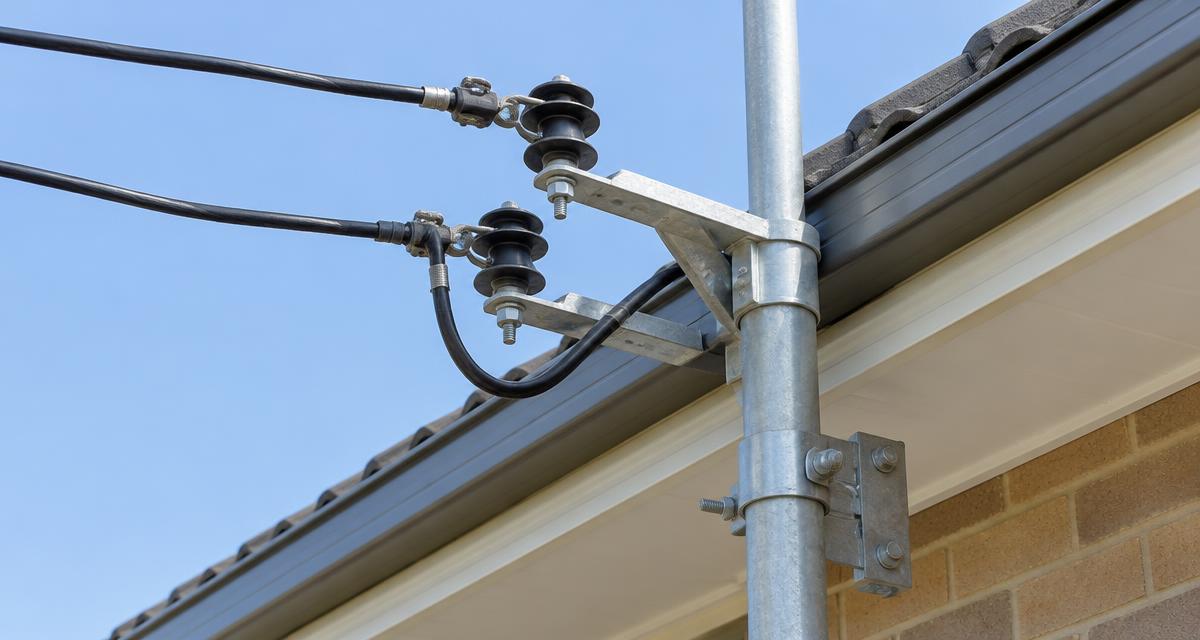
Illustrative attachment image, not a compliant installation specification or a completed Braytech job.
Key takeaways
- The attachment supports the overhead service; it is not necessarily the same place as the electrical point of supply.
- Loose fittings, deteriorated fascia and sagging wires can involve both electrical and structural work.
- Turning off the house main switch does not make incoming service wires safe to handle.
- Plan electrical isolation before roof, fascia or renovation work near the service attachment.
- Relocation requires a suitable new support and service arrangement, not just moving a bracket.
What is an electrical point of attachment?
The point of attachment is the mechanical support for the overhead electricity service at your property. Depending on the installation, it can include a bracket, supporting hardware and insulators at a building or service structure. Its purpose is to carry the forces from the service wires without the attachment or supporting structure failing.
It is easy to confuse this with the electrical connection point, where the network and customer installation meet. The April 2026 NSW Service and Installation Rules define the connection point separately from the mechanical point of attachment. Network homeowner guidance also uses ‘point of supply’ when explaining ownership. Check the actual service arrangement before deciding who owns the wires, fittings or support.
Where is it normally located, and what connects to it?
On an overhead-supplied house, the attachment may be near the roof edge, mounted on a suitable bracket or supported by a service riser. Some properties use a pole or another approved structure instead. The arrangement depends on the building, cable route and network requirements; there is no single fitting that every NSW house uses.
The incoming overhead service spans from the supply arrangement towards this support. Electrical connections then feed the customer installation. From there, consumer mains carry supply towards the main switchboard. These components work together, but the mechanical support, service conductors and customer cables should be identified separately when assessing a defect.
You can note the location from the ground for an enquiry. Do not use a ladder, lift roofing or open equipment to investigate it. An overhead cable can remain energised even when the house has no power, and a nearby metal gutter or bracket can become hazardous if damaged conductors contact it.
Why does the attachment matter so much?
The service wires place load on the attachment and its supporting structure. If a bracket loosens or the building material deteriorates, the support can move and the wire arrangement can change. That may affect cable clearance, damage connected fittings or create a contact hazard.
The issue is not just whether electricity still works inside. A failing attachment can continue supplying a house while the mechanical support is unsafe. Conversely, a damaged fascia does not prove the entire service must be replaced. The contractor needs to assess both the support and the electrical equipment before defining the repair.
Common point-of-attachment defects
Problems can start at the bracket, its fasteners, the surrounding building material or the service wire arrangement. Do not test a loose bracket by moving it. A visual observation from a safe location can help describe the problem, but the repair decision requires an assessment of the actual structure and equipment.
- Loose, damaged or corroded brackets and fasteners that no longer securely support the service.
- Deteriorated timber fascia or another weakened building support around the fixing point.
- Damaged insulators, fittings or connected equipment, including after impact or storm damage.
- A sagging or displaced service line, or a changed relationship to a driveway, roof or building extension.
- Roof or fascia work that has removed, altered or concealed part of the attachment support.
- Movement after severe weather, fallen branches or changes to the supporting structure.
What happens if your point of attachment fails inspection?
The network may issue a defect notice identifying the problem and required action. Read the notice’s description and deadline, then give the full document to the contractor. It may refer to the attachment, supporting structure, service wires or several related items, so a quotation based only on ‘replace bracket’ can miss part of the scope.
An immediate hazard may need the supply made safe or disconnected rather than left until a routine appointment. Keep clear of fallen, low or damaged wires and report them to the network’s emergency service. Call 000 if there is fire or immediate danger to life. Do not touch the attachment or nearby conductive objects to investigate.
- Keep the complete notice and check its reference, defect description and stated deadline.
- Arrange an assessment with a licensed contractor; ask about Level 2 authorisation if service-line work is involved.
- Confirm whether structural repairs, relocation or replacement fittings are needed, and who will carry out each part.
- Agree on isolation, reconnection and any retailer, metering or network coordination before work starts.
- Retain completion records and confirm the defect close-out process with the network.
Who is responsible for attachment repairs?
Responsibility depends on ownership of the affected asset and the network/customer boundary. The customer may be responsible for the building support and customer-owned equipment, while network-owned service equipment is handled under the network’s arrangements. The position of the fitting on the house does not by itself settle ownership of everything attached to it.
Ausgrid’s private poles and powerlines information and Endeavour Energy’s poles and wires guidance explain why private assets and network assets must be distinguished. For the precise service arrangement, the contractor also checks the applicable NSW Service and Installation Rules.
Ask the contractor to explain the boundary in ordinary language and identify who authorises each repair. On a strata or shared property, confirm who owns the relevant building support before engaging building trades. Do not assume that because the network issued the notice, it will perform or pay for all customer-side repairs.
Who can fix it, and when is a Level 2 ASP required?
A homeowner should not repair the attachment or handle the service wires. Electrical work needs an appropriately licensed contractor, and service work requiring network authorisation may need a suitably accredited Level 2 ASP. Accreditation and authorisation must cover the actual task and local network, rather than just the description ‘electrician’.
Building repairs can involve a carpenter, roofer or other relevant trade after the electrical arrangements are made safe. Replacing fascia around a loaded attachment is not ordinary cosmetic work. The electrical and structural scopes need to be coordinated so nobody removes the support while it is carrying the service.
Our point-of-attachment service focuses on repair, replacement and relocation assessment. Level 2 electrical work may be part of the solution where service conductors or connections must be handled. The scope should say clearly which work is required and why.
Does the power need to be disconnected?
Work on the service attachment often needs planned isolation so conductors and mechanical loads can be handled safely. The contractor determines the isolation arrangement for the actual work. Turning off your main switch only controls parts of your installation; it does not make the incoming overhead service safe.
Ask who will perform the disconnect and reconnect work, whether other parties are involved and how the outage will be coordinated. Tell the contractor about medical equipment or other supply-dependent needs before booking. The extent and timing of the interruption depend on the repair scope, not a fixed online promise.
What happens if the point of attachment needs relocating?
Relocation means assessing a new supporting location and a suitable service-wire route. The new support must suit the mechanical load, and cable clearance and connection arrangements must meet the applicable requirements. A convenient spot on new fascia is not automatically an acceptable attachment position.
The change may affect the service length, customer cables, access, appearance and network coordination. Confirm whether consumer mains or other equipment need altering, and whether any structural work is included in the quote. Where a building support is unsuitable, a private power pole may be considered as part of an assessed design, not assumed to be necessary.
How do roofing, fascia work and renovations affect it?
Plan around the attachment before demolition, reroofing or fascia replacement begins. A builder needs to know which structure carries the service and what cannot be disturbed without electrical coordination. Extending a roof or changing access beneath a service line can also alter the suitability of the existing arrangement.
Bring drawings and the proposed work sequence to the electrician early. This lets structural repairs, isolation and any relocation be coordinated before the roof edge is opened up. Do not ask a roofing contractor to detach or temporarily tie up incoming service wires as a shortcut.
An overhead or underground supply change may be worth assessing during major work, but it is not automatically required for an attachment defect. Compare the practical scope of each option, including excavation and reinstatement if underground supply is considered.
What should you send when requesting an assessment?
Provide the property address, full defect notice if there is one, safe ground-level photographs and a description of recent storm damage or planned building work. Mention whether the fitting has moved or wires appear lower than before, without approaching them to measure. Drawings and access details help where relocation is proposed.
Ask for a quote that separates fittings, service work, structural repairs, customer cabling and reconnection arrangements. Check who closes out a defect notice and which work is excluded. The aim is to restore a suitable supported service, not merely replace the visible bracket while leaving its weak support unchanged.
Frequently asked questions
Is the point of attachment the same as the point of supply?
No. The point of attachment mechanically supports an overhead service. The point of supply identifies the electrical network/customer boundary. Their locations can be related, but they describe different functions.
Can I repair a loose attachment bracket myself?
No. The bracket may support energised service wires and a substantial mechanical load. Arrange an assessment by an appropriately licensed contractor, with network-authorised service work where needed.
Who repairs rotten fascia behind the electrical attachment?
The building support may need an appropriate building trade, coordinated with the electrical contractor. The service must be made safe before its support is disturbed; confirm ownership and the full repair scope first.
Will switching off my main switch make the overhead service safe?
No. Incoming service wires can remain energised when the main switch is off. The appropriate authorised party must arrange isolation for supply-side work.
Can the attachment be moved during a renovation?
It may be possible after assessing the new support, service route, clearances and connection requirements. Relocation can involve service and customer-cable changes, so plan it before roof or fascia work starts.
Does an attachment defect always require a new private pole?
No. Some defects can be resolved with suitable fittings and structural repairs. A private pole or underground arrangement is only an option where the assessed service design calls for it.
If you have an attachment defect or roof work planned near the service, send the notice or drawings with your enquiry. The support, wires and building work can then be assessed together.
Related services
Want it looked at properly?
One licensed, family owned team across the Sutherland Shire and St George. Lic. 376321C.