
Private power poles
Private Power Poles in NSW: Who’s Responsible, Defect Notices & Repairs
A private power pole is part of a customer’s electrical installation, rather than the electricity network. Responsibility depends on the connection boundary, not simply whether a pole stands on your land. Confirm ownership before arranging maintenance; a defect notice usually identifies the asset and the action the network expects.
Published 9 October 2026 · Updated 9 October 2026 · 7 min read · Author: Braytech Electrical
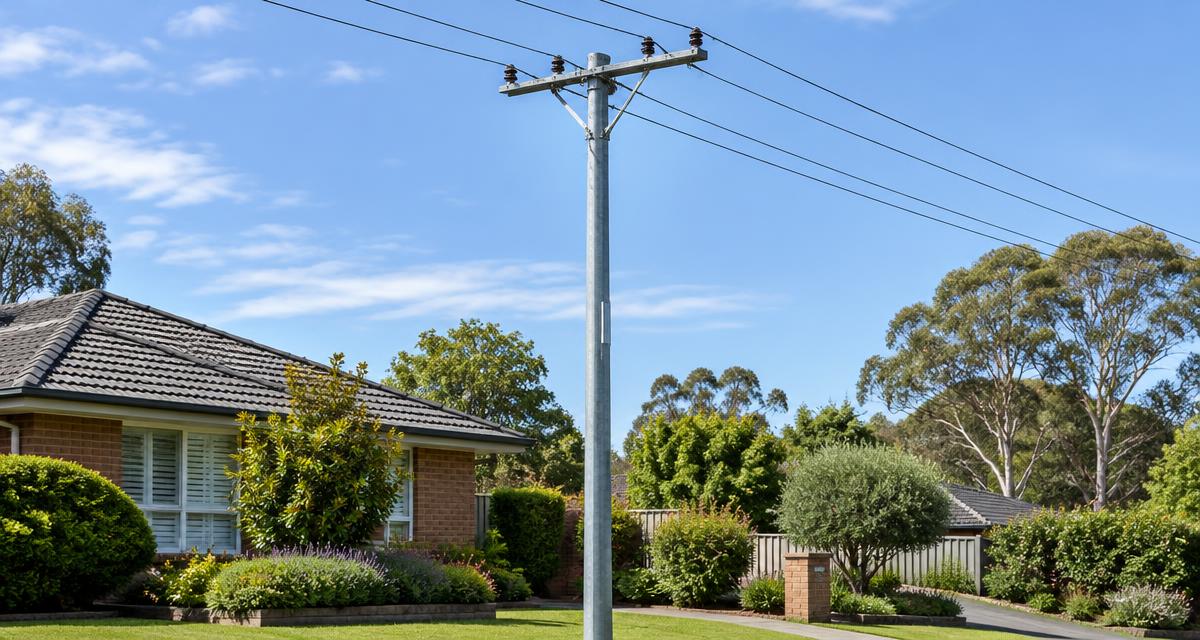
Illustrative image, not a completed Braytech installation. Ownership cannot be established from a photograph.
Key takeaways
- A pole on private land is not automatically privately owned: check the network/customer connection boundary.
- A defect notice needs action by its stated deadline; an immediately unsafe pole or line needs urgent network attention.
- A sound pole with a damaged fitting is a different job from a pole with structural rot, corrosion or movement.
- Supply disconnection and service-line work need the appropriate network authorisation, not DIY repairs.
What is a private power pole?
A private pole supports electrical lines or equipment belonging to the customer installation. It might carry a span across a driveway, support the supply near a house, or form part of a longer private line to a building set back from the street. Its job is structural as well as electrical: it must support the attached equipment and the forces from the wires.
A network pole and a customer pole can look similar. Timber, steel, location and the presence of wires are not enough to settle ownership. Also, the pole, attached service line and other equipment may not all have the same owner. An inspection needs to identify each relevant asset rather than treating everything overhead as one system.
Who is responsible: you or the electricity network?
The network maintains its assets; the customer is responsible for privately owned poles and lines forming part of their installation. The important boundary is the relevant point of supply or connection. It is not automatically your fence, the nearest street pole or the electricity meter.
Ausgrid’s private poles and powerlines guidance explains customer responsibilities for private assets. Endeavour Energy’s property poles and wires information also distinguishes network assets from privately maintained infrastructure. Use the guidance for the network that supplies your property.
If ownership is unclear, ask the network to identify the boundary and have the electrical contractor confirm which parts of the proposed work are customer-owned. For a strata property, shared driveway or leased premises, also establish who can authorise the work. Do not assume the person receiving an electricity bill owns every pole serving the site.
How do you find out whether the pole belongs to you?
Start with any defect notice, connection paperwork, property electrical records or previous installation invoices. A notice may describe a customer pole, private aerial line or a particular fitting. Send the complete notice to the contractor, including any photographs or diagrams, rather than just the first page.
From a safe distance, note where the pole sits and which buildings the wires appear to serve. This helps someone locate it; it does not prove ownership. If records are missing, your network and an appropriately qualified electrical contractor can clarify the installation. Do not climb the pole, open equipment or approach damaged wiring to find a label.
What common problems affect private poles and lines?
Defects can involve the pole itself, its supports, fittings or the wires it carries. A straight-looking pole can still have hidden deterioration, while a leaning pole may indicate loss of support or structural damage. A photograph cannot establish remaining strength.
- Timber rot or termite damage: deterioration can reduce the strength of the pole, including near ground level.
- Corrosion: steel poles, brackets and fasteners can deteriorate, particularly where moisture collects.
- Leaning or movement: changes in alignment, ground conditions or attached loads need assessment.
- Damaged crossarms, insulators or fittings: the pole may be sound but its attached hardware may not be.
- Sagging, damaged or frayed overhead wiring: do not approach it or assume intact insulation makes it safe.
- Vegetation near private lines: branches can interfere with lines; trimming near electricity needs specialist assessment.
Received a private power pole defect notice?
Read the notice and arrange an assessment promptly. A notice identifies a problem, but it is not a complete replacement specification. The repair scope still needs to be confirmed on site, including whether a supply outage or network coordination is required.
- Check the asset description, defect details, reference number and deadline. Keep every page of the notice.
- If the pole is moving, wires are down, or there is arcing or another immediate hazard, keep people away and contact your network’s emergency service. Call 000 for immediate danger to life or fire.
- Contact a licensed electrical contractor and provide the notice. Ask whether the job needs an appropriately accredited and network-authorised Level 2 ASP.
- Have the contractor assess the pole, fittings, connected lines and access before agreeing to repair or replacement.
- Confirm who will arrange isolation, reconnection and the evidence or notification required to close out the defect.
- Keep the completion records and check with the network that the notice has been addressed. Do not assume a booking alone satisfies it.
What if the defect is an immediate safety risk?
A fallen wire, unstable pole or damaged electrical fitting is not a routine quoting job. Keep yourself, other people and animals clear. Do not touch the pole, wire, nearby fence or anything contacting the damaged equipment. Report the hazard to the electricity network and follow its instructions.
An unsafe installation may need to be disconnected before repairs can be planned. Switching off the house’s main switch does not make incoming overhead wires safe. For repairs after the hazard is made safe, emergency Level 2 electrical work may be needed, depending on the damaged equipment and network requirements.
Can the pole be repaired, or does it need replacing?
Repair may be suitable when the pole is structurally sound and the problem is an individual fitting or a section of wiring. Replacement becomes a consideration when deterioration, movement or damage compromises the pole’s ability to support the installation. Painting corrosion or straightening a leaning pole is not evidence that its strength has been restored.
The inspection should also consider the attached lines and nearby point of attachment. Replacing a pole but retaining damaged fittings can leave part of the defect unresolved. Ask a private power pole contractor to separate essential safety work from optional changes, with a clear explanation of why each item is included.
Is timber or steel better for a replacement pole?
There is no universal answer. Pole material, strength, height, footing, exposure and the equipment being supported all matter. Timber needs assessment for decay and pests; steel needs assessment for corrosion. Both depend on suitable installation and maintenance rather than the material name alone.
Ask which options suit the site and applicable network requirements, and how future inspection will be carried out. A replacement design should account for access and the required wire arrangement, not simply copy the visible height of the old pole. Avoid ordering a pole before the electrical and structural scope has been established.
Can an overhead private line be moved underground?
Sometimes, but it is a separate design choice rather than an automatic requirement of a defect notice. Underground supply can remove a particular overhead span, but brings trenching, cable routing, excavation access and reinstatement into the scope. Existing services in the ground and the connection arrangement need to be checked first.
Compare a like-for-like repair with an overhead-to-underground wiring option if it suits future building plans. Confirm whether the pole can actually be removed, which approvals are needed and who restores driveways or landscaping. Do not assume underground means maintenance-free or suitable everywhere.
When is Level 2 ASP work needed, and who reconnects power?
A licensed electrician assesses and works on customer electrical installations. Where the job involves service connections, service-line changes or work requiring network authorisation, an appropriately accredited Level 2 ASP may be needed. The precise authorisation must cover the task and the local network; a general electrical licence alone is not permission to work on network service equipment.
Disconnection and reconnection should be planned by the contractor with the relevant authorised parties. Ask who is responsible for each stage, including any metering involvement. Homeowners should never pull service fuses, loosen overhead wires or attempt temporary pole repairs while waiting for an appointment.
What information helps you get a useful quote?
Provide the address, network name if known, the full defect notice, safe ground-level photographs, access details and any planned building work. Mention shared access, a locked gate, sensitive equipment or people who depend on a reliable supply. Do not move closer to a suspected hazard to improve a photograph.
Ask the quote to identify ownership assumptions, repair versus replacement scope, line and fitting work, isolation arrangements, site reinstatement and defect close-out responsibilities. A pole-only price cannot be compared fairly with a quote that also includes damaged wiring and reconnection. The right next step is an inspection-based scope, not guessing the repair from the pole’s appearance.
Frequently asked questions
Is every power pole on private land privately owned?
No. Location alone does not establish ownership. The network/customer connection boundary and the particular asset determine responsibility; check with your network if records are unclear.
Who pays to fix a private power pole?
The owner is generally responsible for privately owned electrical infrastructure. Confirm asset ownership and the repair scope with the network and contractor before authorising work, especially on shared or strata sites.
Does a defect notice mean the pole must be replaced?
Not necessarily. A notice may identify a fitting, wiring or structural problem. An assessment determines whether repair is suitable or the pole needs replacement; follow the notice’s stated requirements and deadline.
Can I trim branches around my private powerline?
Do not attempt vegetation work near electrical lines yourself. Ask the network or an appropriately qualified contractor how the work can be made safe, including whether isolation is needed.
Does turning off my main switch make the pole safe?
No. The incoming service and overhead wires can remain energised with the house’s main switch off. Isolation of supply-side equipment must be arranged by the appropriate authorised party.
Can a private overhead line be replaced with underground supply?
It may be possible after assessing the connection, cable route, excavation and applicable network requirements. Underground conversion is a separate scope and is not automatically necessary to resolve every pole defect.
Have a pole notice or an uncertain ownership boundary? Send the notice and safe photographs with your enquiry so the assessment starts with the actual defect, not an assumed replacement.
Related services
Want it looked at properly?
One licensed, family owned team across the Sutherland Shire and St George. Lic. 376321C.